Hydrogen has a crucial role to play in delivering a cleaner and more resilient rail network, the Hydrogen Energy Association (HEA) has highlighted.
The UK’s leading hydrogen trade association emphasised hydrogen’s importance in decarbonising transport systems – particularly rail routes where electrification is impractical or cost-prohibitive.
It comes as the HEA supported a number of its members at a landmark event demonstrating hydrogen’s role in decarbonising the UK’s rail network and advancing sustainable transport.
Dr Emma Guthrie, CEO of the HEA, underscored rail’s potential not just as a hydrogen user but as a key enabler for transporting the fuel, positioning it as an integral part of the UK’s wider hydrogen strategy.
“Hydrogen has an important role to play in decarbonising land transport – whether on road, off-road, or rail – by acting as a zero-carbon fuel, particularly in areas where battery technologies may face limitations,” she said. “For rail, this means offering a viable alternative for routes that are challenging or costly to electrify.
“Rail also has significant potential to support the transport of hydrogen itself, as transport and storage become essential pieces of the wider hydrogen strategy.”
HEA members GeoPura, Vanguard Sustainable Transport Solutions, and ULEMCo took part in the “Five Hydrogen Firsts” event last week (Wednesday 3 December), facilitated by Network Rail at their Tuxford Test Tracks in Nottinghamshire.
The event brought together representatives from government, energy, logistics, and rail, to showcase hydrogen innovation across the entire value chain of production, storage, and transport.
The day marked the first UK use of rail to move hydrogen as a commodity, with Freightliner moving a train of hydrogen gas containers from Doncaster to High Marnham.
The hydrogen was produced at nearby HyMarnham Power, a joint venture between HEA member GeoPura and JG Pears, which is set to become one of the world’s first rail-connected hydrogen production facilities.
This marks a major step towards the rail network becoming a ready-made hydrogen distribution system, a rolling pipeline, with connections to all major industrial and urban centres across Britain – proving the practical capability of rail to transport hydrogen at scale.
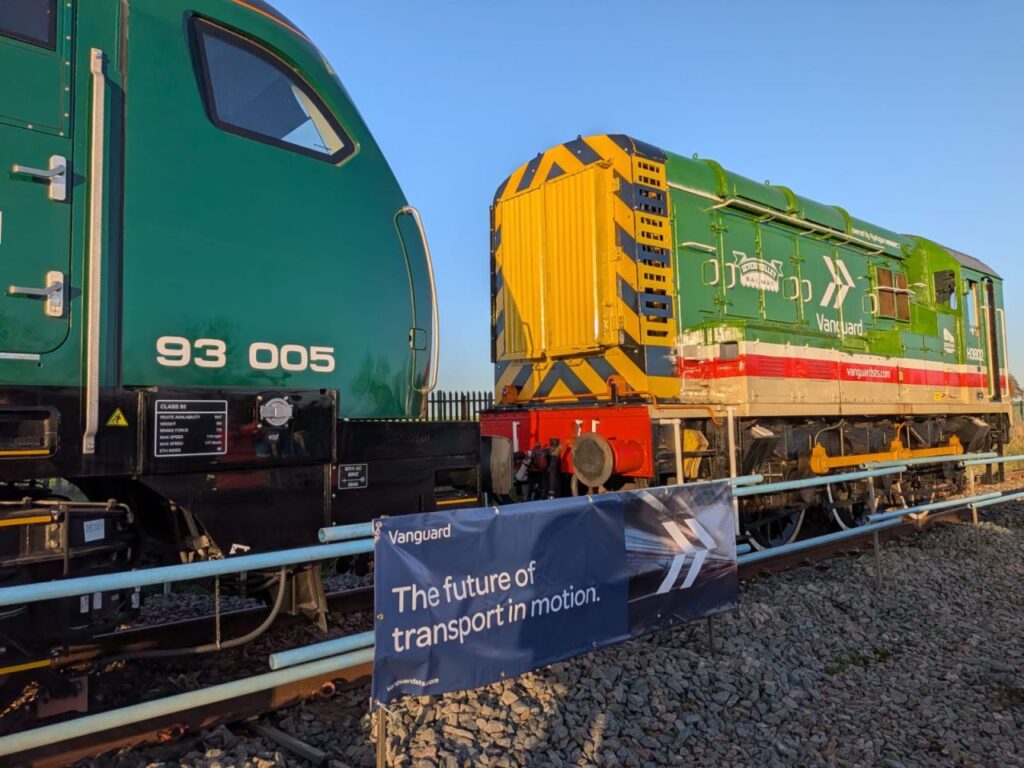
It featured Vanguard’s UK-first hydrogen-powered shunting locomotive, and was powered by GeoPura’s HPU fuel cell technology. This technology will be used to decarbonise wider rail operations, from construction to ongoing maintenance and off-grid operations. It demonstrates how rail can serve both as a means of decarbonising vehicles and as a backbone for transporting hydrogen across the country.
Dr Alexander Burrows, Chief Strategy Officer at Vanguard, a sustainable technology company driving the decarbonisation of heavy transport through hydrogen and battery solutions, said:
“The need for decarbonisation of our transport networks is clear. The potential for hydrogen to support transport decarbonisation is significant and the technology is ready. As a UK SME we are thrilled to be supporting events such as this that demonstrate the application of our technology.
“The railway will require a range of technologies to enable decarbonisation, including battery and hydrogen. Our shunter locomotive can provide the required operational performance to deliver zero emissions operations for railway operators right now.
“Our groundbreaking partnership with the Severn Valley Railway to deliver this new Shunter powertrain has demonstrated a truly innovative approach focused on both technology and skills through a unique collaboration between a university spinout and a heritage railway. We are hugely proud of what we have achieved together.”
Andrew Cunningham, CEO at GeoPura, said:
“Hydrogen has a vital role in removing diesel from Britain’s rail network, providing zero-emission power where electrification alone cannot reach. Excitingly, we’re also showing that the rail network is a great way of transporting clean fuel to connected customers who can’t get the power they need from the traditional distribution grid.
“By supplying locally produced green hydrogen from HyMarnham Power to this first-of-its-kind rail application, we’re showing that clean fuel, proven technology, and existing rail infrastructure work together right now to cut carbon and improve air quality across the network. GeoPura is delighted to support Network Rail and its partners as they show what the future of a net-zero railway looks like in practice.”
Amanda Lyne, Chair of the Hydrogen Energy Association and Managing Director of ULEMCo, said:
“Hydrogen, as a zero-carbon fuel, is essential to decarbonise mobile heavy-duty use applications such as goods vehicles, coaches, large vans, off-road equipment and in rail itself where the cost of providing wires and cables are prohibitive, and overall sustained power needs are not viable with battery and electric solutions alone. Transporting hydrogen on rail is an excellent way of moving the fuel to where it is needed, and this ground-breaking demonstration provides a real opportunity for the UK to show we are leading the way.”
Dr Guthrie added: “I’m delighted that several HEA members played an active role in the ‘firsts’ we witnessed at Tuxford. Events such as this highlight hydrogen’s vital role in land transport innovation.”
The “Five Hydrogen Firsts” at the event – attended by representatives from across government, the energy, logistics and rail industries – were: the world’s first rail-connected green hydrogen production facility; the UK’s first use of rail to move hydrogen as a commodity; the UK’s first hydrogen-powered shunting locomotive; the UK’s first joint railway-energy industry innovation zone; and the world’s first net zero railway testing facility.
The event reflected a partnership spanning multiple organisations and industries. Network Rail, Freightliner, HyMarnham Power, GeoPura, Vanguard, Enspired Consulting, Rail Operations Group, Toyota UK, Jeff Vehicles Ltd, Fuel Cell Systems and others highlighted the potential to move hydrogen at scale, replace diesel locomotives, and link the UK’s largest green hydrogen production site directly to the railway network.